🇺🇸 Veteran-Owned & Operated: Integrity You Can Trust
📍 Experts in Fencing on Pittsburgh’s Hills & Slopes
📅 Free On-Site Consultation – Honest Pricing, No Pressure
🚛 Daily Installs in Bethel Park, Washington & Coraopolis
🛠️ Custom Stick-Built Fencing: No Pre-Made Panels!
✨ Maintenance-Free Vinyl: Never Paint or Stain Again!
🪜 Secure Handrails: Safety for Your Porch & Stairs
❄️ Built Tough to Withstand PA Winters & High Winds
🇺🇸 Veteran-Owned & Operated: Integrity You Can Trust
📍 Experts in Fencing on Pittsburgh’s Hills & Slopes
📅 Free On-Site Consultation – Honest Pricing, No Pressure
🚛 Daily Installs in Bethel Park, Washington & Coraopolis
🛠️ Custom Stick-Built Fencing: No Pre-Made Panels!
✨ Maintenance-Free Vinyl: Never Paint or Stain Again!
🪜 Secure Handrails: Safety for Your Porch & Stairs
❄️ Built Tough to Withstand PA Winters & High Winds
🇺🇸 Veteran-Owned & Operated: Integrity You Can Trust
📍 Experts in Fencing on Pittsburgh’s Hills & Slopes
📅 Free On-Site Consultation – Honest Pricing, No Pressure
🚛 Daily Installs in Bethel Park, Washington & Coraopolis
🛠️ Custom Stick-Built Fencing: No Pre-Made Panels!
✨ Maintenance-Free Vinyl: Never Paint or Stain Again!
🪜 Secure Handrails: Safety for Your Porch & Stairs
❄️ Built Tough to Withstand PA Winters & High Winds
🇺🇸 Veteran-Owned & Operated: Integrity You Can Trust
📍 Experts in Fencing on Pittsburgh’s Hills & Slopes
📅 Free On-Site Consultation – Honest Pricing, No Pressure
🚛 Daily Installs in Bethel Park, Washington & Coraopolis
🛠️ Custom Stick-Built Fencing: No Pre-Made Panels!
✨ Maintenance-Free Vinyl: Never Paint or Stain Again!
🪜 Secure Handrails: Safety for Your Porch & Stairs
❄️ Built Tough to Withstand PA Winters & High Winds
Correctly setting the stair handrail height is more than a finishing detail in a home improvement project. It is a fundamental requirement for both structural safety and legal compliance, especially when considering the standard handrail height outlined in local building codes.
From a dimly lit basement staircase to a grand commercial entrance, the handrail provides the primary safeguard against slips and falls. Understanding the difference between a guardrail vs. handrail is equally important: a handrail offers a secure grip for balance, while a guardrail serves as a protective barrier along elevated edges. Together, these elements form part of carefully designed fall protection systems that help prevent accidents and ensure that every person, regardless of age or mobility, has reliable support when it matters most just as thoughtful exterior upgrades like backyard wood fence upgrade ideas improve safety and functionality around the home.
Commercial Stair Handrail Height vs. Residential Requirements
When it comes to staircase design, one size does not always fit all. The height requirements for handrails often fluctuate depending on the building’s primary use.
Residential Requirements: In most private homes, stair handrail height is governed by the International Residential Code (IRC). The standard is designed for the average height of family members, providing a comfortable lean and grip.
Commercial Requirements: For businesses, schools, and apartment complexes, the International Building Code (IBC) takes over. These municipal construction codes are often stricter because they must account for high traffic volume and a wider demographic of users, including those with disabilities. In many cases, facility managers also coordinate with local fence installers in Beaver PA to maintain safety standards across the entire property perimeter.
While the numerical height ranges often overlap, commercial settings may have additional requirements regarding the diameter of the rail and the clearance between the rail and the wall to ensure maximum accessibility. For homeowners planning broader exterior improvements, it can also be helpful to understand factors like fence installation time for homeowners when scheduling multiple property upgrades.
OSHA vs. IRC Handrail Height Requirements: What’s the Difference?
Understanding the distinction between OSHA handrail standards and IRC handrail height is critical for contractors and property owners alike, and professional installers such as those providing Beaver Falls handrail installation services ensure every project meets the appropriate codes.
The Occupational Safety and Health Administration (OSHA) focuses on workplace safety. OSHA 1910.29(f) generally requires handrails to be between 30 and 38 inches. However, recent updates have aimed to bring these closer to building codes. OSHA standards are specifically tailored for industrial environments where workers might be carrying tools or wearing heavy gear, which is why property managers often follow professional guidance similar to the tips for selecting a commercial fence contractor when evaluating safety-focused installations.
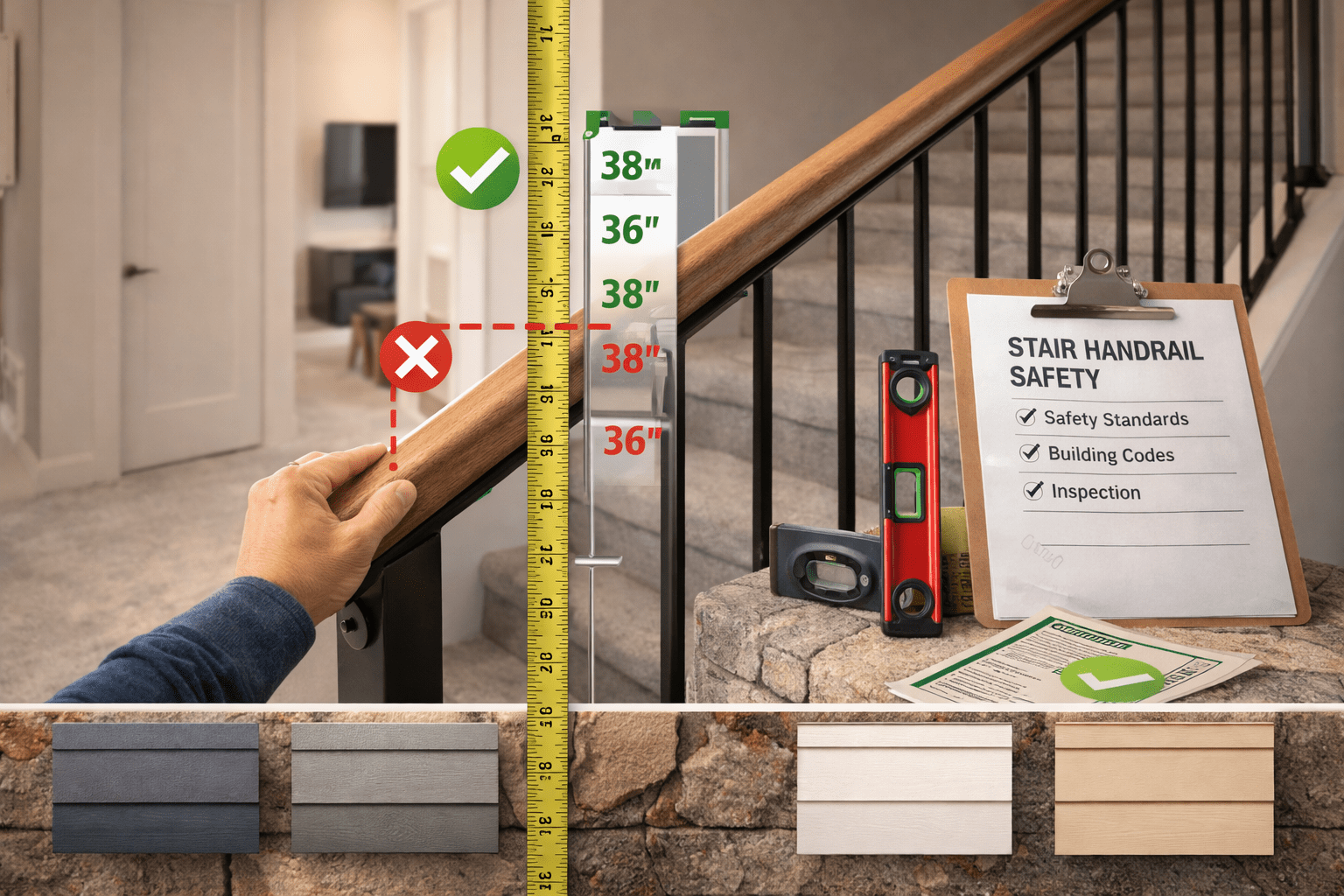
Conversely, the IRC (International Residential Code) is the gold standard for professional residential exterior upgrades. The IRC stipulates that handrail height must be a minimum of 34 inches and a maximum of 38 inches.
Whether you are installing metal handrails in a warehouse or aluminum railing systems on a backyard deck, staying within the 34 to 38 inch “sweet spot” is generally the safest way to ensure compliance across the board. The same attention to structural compatibility applies when choosing railing solutions for split level house layouts where elevation changes require careful design.
How to Measure Stair Handrail Height Correctly
Precision is key during a stair tread measurement. A handrail that is even an inch too low can fail a home inspection and create a significant trip hazard, which is why many homeowners trust experts offering custom fence installation in Beaver Falls and related exterior improvement services.
Find the Nosing: Identify the nosing, which is the leading edge, of your stair treads.
The Plumb Line: Imagine a vertical line rising straight up from the nosing.
The Measurement: Measure from the top of the stair tread nosing to the top of the handrail.
Consistency: Repeat this measurement on the bottom step and the top step. The rail must run parallel to the slope of the stairs.
Don’t forget handrail extension requirements. In many jurisdictions, the handrail must extend beyond the top and bottom risers to allow a person to stabilize themselves before they actually begin their ascent or descent. Following these details is part of the broader approach recommended in modern home exterior improvement tips that prioritize both design and safety.
Why Proper Stair Handrail Height Is Critical for Safety
The primary goal of stairway fall prevention is to provide a “power grip.” If a handrail is too low, a person may overbalance while reaching for it. If it is too high, children or shorter adults may not be able to reach it in an emergency one of the many safety considerations also addressed in projects like commercial gate operator installation in Pittsburgh where accessibility and safety must work together.
Beyond physical safety, construction compliance protects property owners from liability. A code-compliant railing is a prerequisite for passing inspections and securing insurance coverage. In the event of an accident, having a railing that meets local municipal construction codes serves as documented proof that the property owner prioritized safety, much like installing driveway gate systems for property value can enhance both security and long-term investment value.
When Are Guardrails Required in Addition to Handrails?
There is often confusion between a handrail and a guardrail.
Handrails are the narrow rails you grasp with your hand for balance.
Guardrails, or guards, are designed to prevent someone from falling off the side of an open elevated surface.
If your outdoor stairs have a total rise of more than 30 inches above the floor or grade below, the IRC requires a guardrail. In these cases, the guardrail must be at least 36 inches high (42 inches for commercial), and the handrail is often mounted to the side of it or integrated at the correct stair handrail height. Similar access considerations also apply when planning commercial property vehicle entry systems for large facilities.
Common Stair Handrail Code Violations to Avoid
Even seasoned DIYers can fall into traps that lead to failed home inspections. Avoid these common mistakes:
The “Wavy” Rail: Handrails that do not maintain a consistent height relative to the stair nosing.
Improper Ends: Failing to return the handrail into a wall or a sturdy post to prevent clothing from snagging.
Incorrect Clearance: Placing the rail too close to the wall, which prevents a full grip.
Missing Extensions: Cutting the rail off exactly at the last step instead of extending it as required by code.
When Should You Hire Professionals for Code-Compliant Handrail Installation?
While installing a handrail might seem like a simple weekend project, the legal and safety stakes are high. One wrong measurement can result in a costly tear-out and redo, which is why many property owners rely on professionals experienced in custom fence installation in Pittsburgh and related exterior safety structures.
At Pro Fence & Railing, we specialize in code-compliant installation services. Our team understands the nuances of local codes and the structural requirements of different materials. When you meet our professional railing specialists, you are gaining peace of mind that your home or business is protected. From high-quality aluminum railing systems to custom metal handrails, we ensure that every bolt and bracket meets the highest industry standards.
FAQs
What is the standard stair handrail height in residential buildings?
In the United States, the IRC requires residential handrails to be between 34 and 38 inches high, measured vertically from the nosing of the stair treads.
What is the OSHA requirement for stair handrail height?
OSHA standards typically require handrail heights to be between 30 and 38 inches, though they are increasingly aligning with the 34 to 38 inch range used in general building codes.
How high should a stair handrail be from the tread?
The handrail should be 34 to 38 inches above the stair tread nosing. This height must be consistent throughout the entire flight of stairs.
What is the difference between a handrail and a guardrail?
A handrail is designed for grasping for balance while climbing stairs. A guardrail is a barrier designed to prevent people from falling off the side of an elevated platform or staircase.
Do outdoor stairs require a specific handrail height?
Yes, outdoor stairs follow the same IRC or IBC codes as indoor stairs, typically requiring a height of 34 to 38 inches for residential applications.
Is there a maximum stair handrail height limit?
Yes, under the IRC, the maximum height for a residential handrail is 38 inches. Anything higher may be considered a guardrail rather than a graspable handrail.
How do I measure stair handrail height correctly?
Measure vertically from the leading edge (nosing) of the stair tread to the top surface of the handrail. Do not measure from the back of the tread or the middle.
Are commercial handrail height requirements different from residential?
While the height range is often the same, commercial codes like IBC or ADA have stricter rules regarding rail diameter, clearance, and extensions.
Does stair handrail height affect home inspections?
Absolutely. An incorrect handrail height is one of the most common reasons for a failed home inspection during a sale or renovation.
When are handrail extensions required by code?
Extensions are generally required in commercial settings and some residential jurisdictions to ensure a person can hold the rail before the first step and after the last, a detail often incorporated into custom handrail solutions in Pittsburgh designed for both safety and code compliance.
Conclusion
The stair handrail height on your property is more than a measurement; it is a commitment to safety. By adhering to IRC, OSHA, and local municipal construction codes, you protect your guests, your employees, and yourself from avoidable accidents. Do not leave your safety to chance. Trust Pro Fence & Railing for your next project. Whether you need professional residential exterior upgrades or complex code-compliant installation services, we have the expertise to get it done right the first time. Contact Pro Fence & Railing today to ensure your stair railing installation meets every safety and code requirement.




 Residential Fencing
 Ornamental / Decorative Fence
 Fence Installation
 Handrails
 Photo Gallery
 Testimonials
 Blog
Blog Case Studies
 Coupons
 Financing